Sam Rodgers Homes
Sarasota, Venice & Bradenton, FL
A 1968 builder's inventory, finally on the website — and a dashboard that runs it.
- 75 homesites across three communities as first-class database records
- Public lot maps that redraw themselves from live inventory
- A home-builder CRM scoped to four questions, not to Salesforce

2 imagesdrag to move · click to open
The website was the last to know
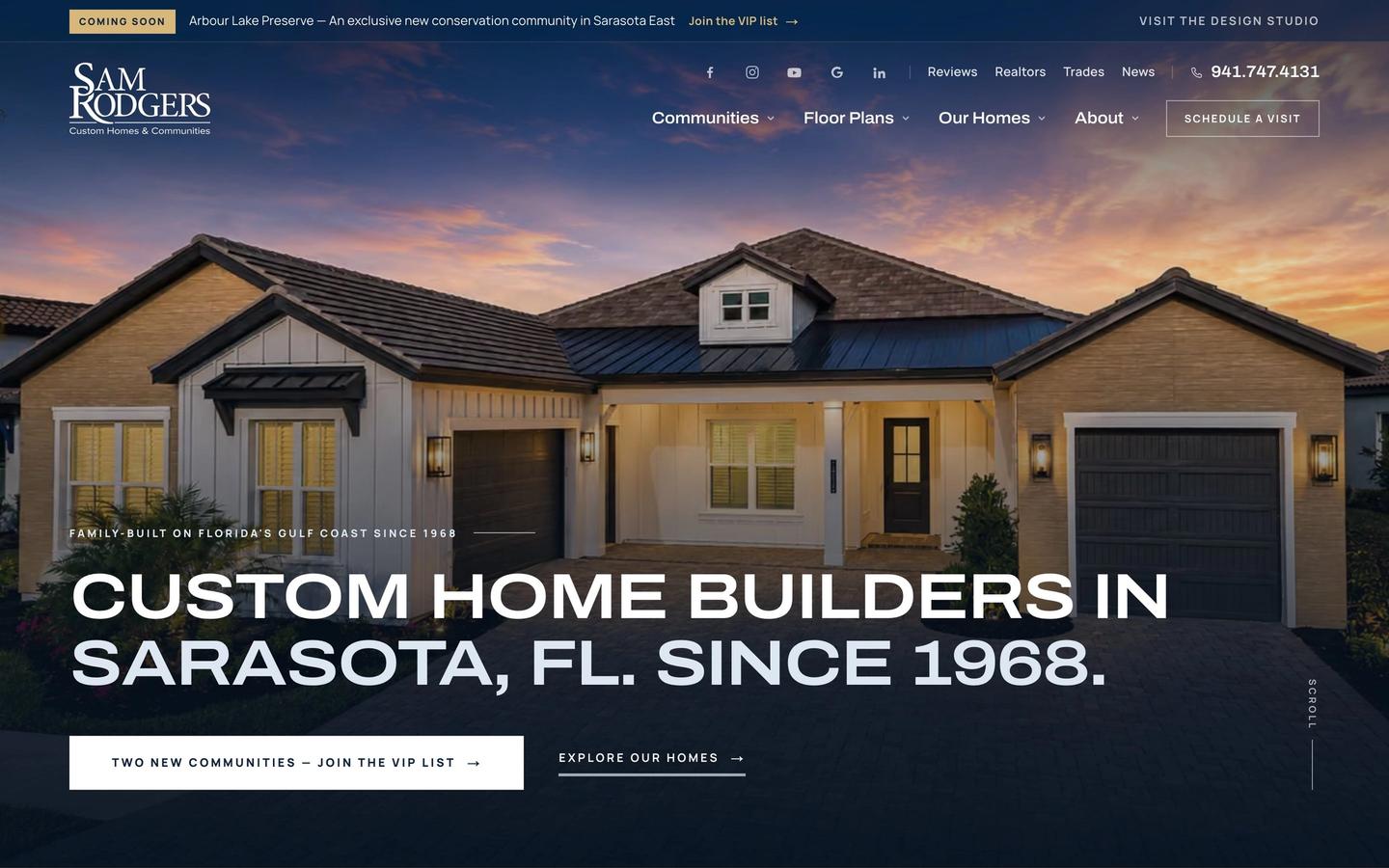
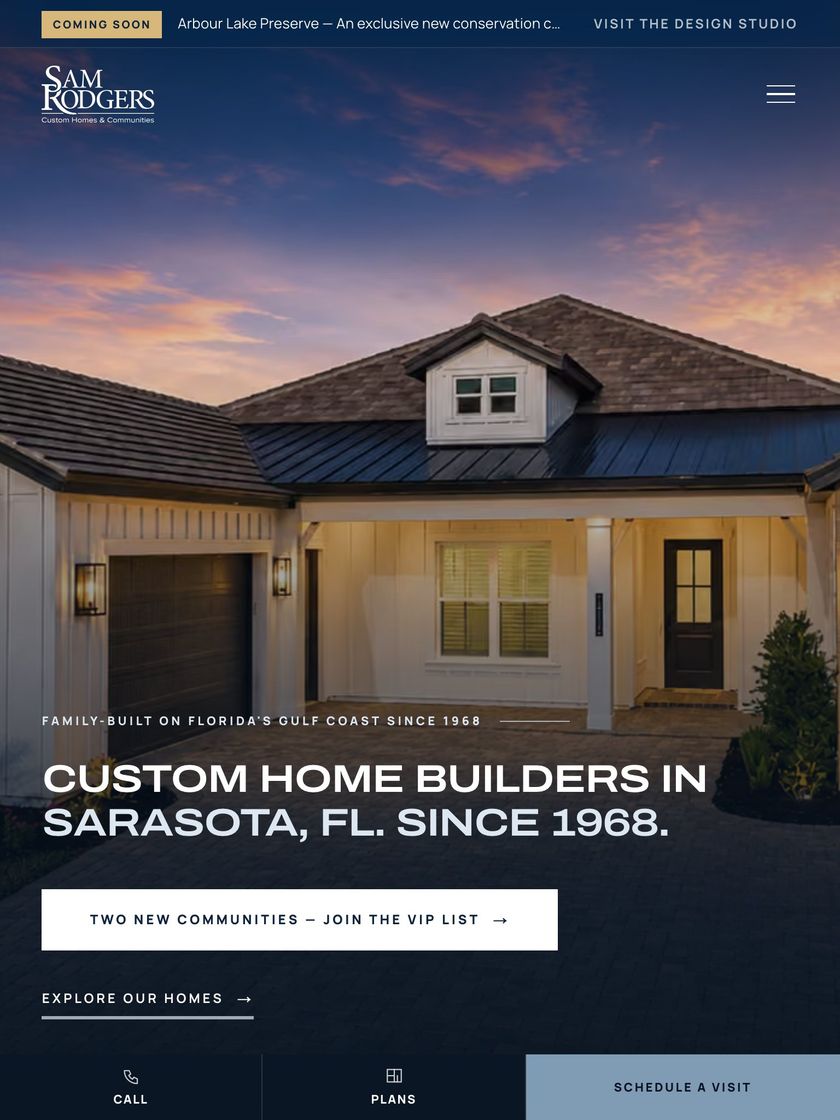
Sam Rodgers has been building in Sarasota since 1968. The positioning came straight off their own sales floor — when other builders say no, Sam says yes — and it is set on the site in Sam's own signature, because a semi-custom builder's entire pitch is the willingness to change the plan.
What the old site could not do was answer the only questions a buyer actually has. Which homesites are left. What do they cost. What can I build there. All of that existed, but it lived in the sales office and in a data file that only a developer could edit.
One register, many views
Rather than build a website feature and a sales tool and a reporting layer, we built one register and pointed everything at it. A homesite is a record. Inventory, the pipeline, active builds, design-studio selections, construction specifications and the public lot maps are all just different questions asked of the same rows.
That decision is why the site cannot drift from reality. There is no second copy of the inventory to forget to update. The map on the public site and the register in the sales office are the same data, read twice.
A CRM that answers four questions
A twelve-person builder does not need enterprise sales software. It needs four questions answered fast: where is everyone in the funnel, what happened last with this person, which homesite are they asking about, and once they commit, what exactly is being built for them. Everything else was deliberately left out.
Enquiries link themselves — a form sent from a specific home's page files under that home's lot automatically. Notes are append-only and dated, because a note you can quietly edit afterwards is a record someone can argue with.
Handing over the keys
Every photograph on the Our Story page — the header, the founder, each milestone on the timeline, the whole archive strip — became an editable field, and each one arrived already holding the picture the site was showing. That last part is the whole trick: an empty field is not a neutral starting state, it is a trap that turns a client's first edit into a deletion.
What shipped
The site now leads with inventory: two communities, sixty-four homesites, every available home with real pricing and live status, and the Arbour Lake floor plans browsable by name. The leads table became a working sales board with the office's own stages — touring, design studio, under contract — and an append-only dated activity trail. A launch-night performance problem was fixed and verified under phone-grade throttling: the page that took 9.4 seconds to paint its largest element now does it in 0.87. Thirty-one older blog posts were restructured with real section headings in a single transaction, and a Monday-morning report now emails the week's numbers pulled live from Analytics, Search Console, the Google listing and the leads table.
A semi-custom builder founded in 1968 was selling million-dollar homes through a website that could not show a homesite, a floor plan, or a price without a phone call. Lot statuses lived in a JSON file in a git repository, with a note in the code that read "when Kari confirms, fill each status." Confirming a lot release is a thing a sales office does on a Tuesday morning — not something that should require a developer and a deployment.
We found the smallest true center of the business and built everything as a view of it: the lot as a database record. Seventy-five homesites across three communities, each carrying its own status, price, plan, elevation, address, story and MLS number. A register per community with one-click status flips and a publish switch. The public lot maps read live status and price straight from that register, falling back to neutral pre-release data if the database ever goes quiet — so flipping a lot to Sold in the dashboard makes the website right on the next request.
- 75 homesites across three communities as first-class database records
- Public lot maps that redraw themselves from live inventory
- A home-builder CRM scoped to four questions, not to Salesforce
- 9.4s → 0.87s largest-paint, verified under throttling
- Every photograph on Our Story editable, each seeded with what was already live
Trusted by leading Florida businesses