
Development & Growth
Sarasota–Manatee, FL
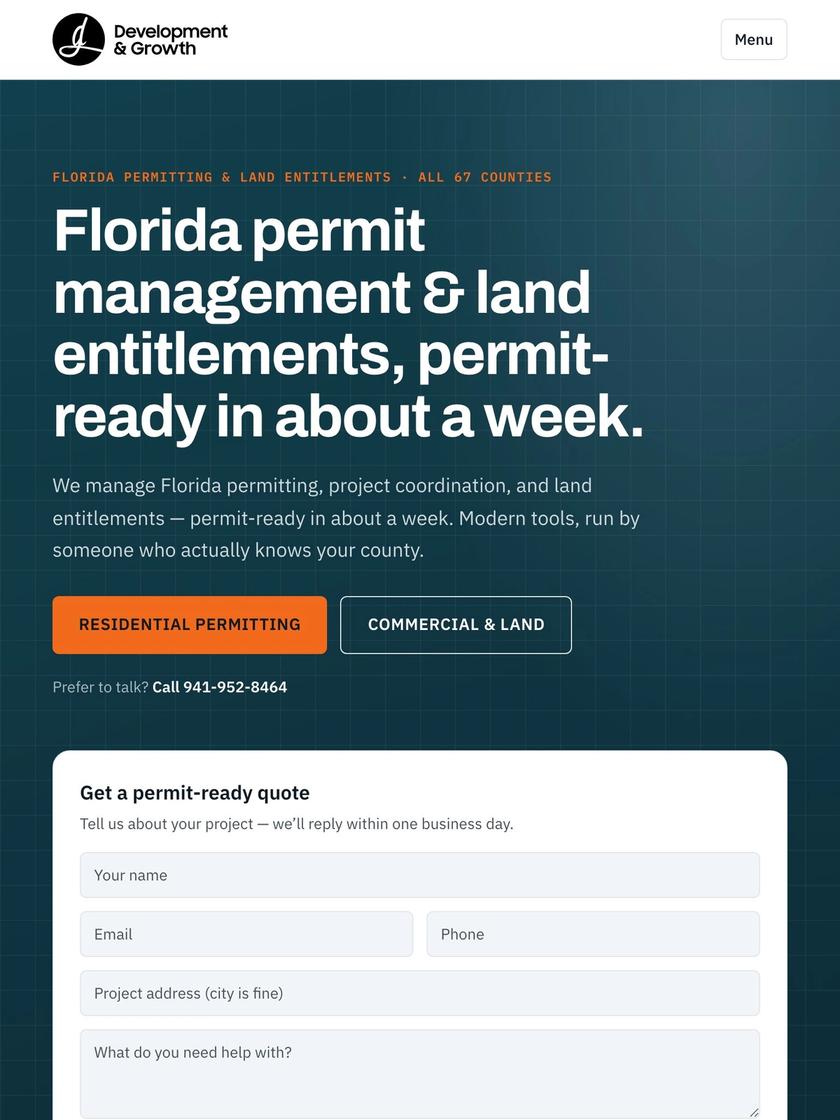
Florida permit management and land entitlements — permit-ready in about a week.
- Two buyer tracks — residential builders and commercial landowners
- Real dollar outcomes named, not adjectives
- 16 service pages spanning intake through issued permit


2 imagesdrag to move · click to open
Proof, not adjectives
The section that carries this site is called exactly that. Instead of claiming expertise it names four projects and what happened on each: an impact fee reduced by three thousand dollars, a parcel that went from a $459,000 purchase to a $6–7M appraisal once it was entitled, a flood-zone custom home coordinated to approval, and a 233,936 square-foot downtown entitlement.
Every one of those is checkable. That is the point. In a market where the competition is a wall of adjectives, specificity is the whole differentiator.
Two buyers, two doors
A custom-home builder needing a permit pulled and a landowner trying to entitle raw acreage are not the same customer. They have different timelines, different vocabularies and different definitions of done. The site splits at the top and never makes either of them read the other's page.
Migrating a site days after its SEO launch
The ask arrived as a feature request — make the site click-to-edit, the way we had for another client. The real problem surfaced immediately: half the pages had never lived in the CMS at all, including 67 county pages that had been submitted to Google days earlier. The request quietly became a full content migration on top of a search launch that had not yet settled.
So we did not trust the swap, we proved it. Before touching anything, we snapshotted the SEO-critical surface of all 182 pages — every title, every heading, the structured data, and a fingerprint of each page's text. Every migration wave then had to diff byte-for-byte clean against that baseline before it was allowed to ship. A ranking you cannot see moving is still moving; the baseline is what makes it visible.
67 pages that stay different
The county pages kept their engine rather than becoming CMS documents. David edits the facts — county seat, the cities covered, one real distinguishing note — and code assembles the page from them.
That boundary is deliberate. Hand an editor 67 free-text pages and you have created 67 opportunities to paste the same paragraph, which is exactly how a county-page strategy dies. Hand them 67 fact sheets and the pages stay differentiated by construction.
Permitting and land entitlement is a field where every competitor says the same four adjectives — fast, experienced, local, trusted — and none of them prove anything. The work itself is genuinely technical and genuinely valuable, and none of that was visible.
We built the site around evidence instead of claims. Two clear tracks for two different buyers: builders and custom homes on one side, developers and landowners on the other. A quote form sits in the hero rather than at the bottom of a contact page. And the proof section names real projects with real numbers.
- 182 pages migrated into the CMS without moving a search ranking
- 67 county pages where the client edits facts and code assembles the copy
- A byte-for-byte SEO baseline every migration wave had to diff clean against
- Click-to-edit on every page, publishing without a developer
Trusted by leading Florida businesses