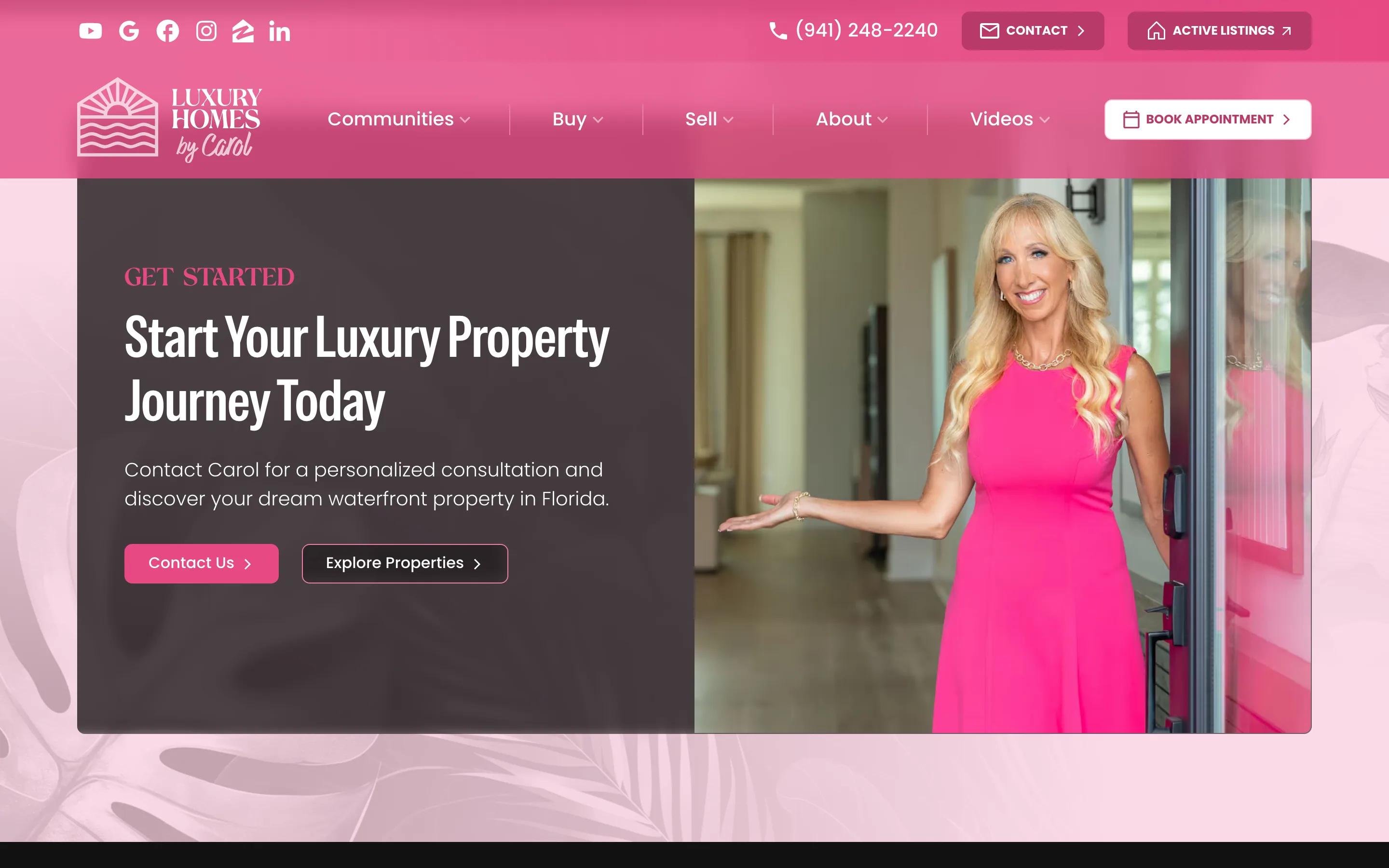

Real estate — brokers, teams, brokerages, luxury agents — is a vertical where personal brand and market expertise ARE the product. Different from rental property sites entirely. This is the agent-as-personality positioning play. The buyer/seller is choosing the human first, the brokerage second, the listings third. Marketing has to reflect that hierarchy.
What real estate agent marketing needs
- Personal brand identity — see Brand & Identity for Premium Clients. The agent's face, voice, story.
- Local market expertise content — neighborhood deep-dives, market reports, the kind of content that proves real knowledge of a specific zip code or community.
- IDX integration — listing feed integrated with the brokerage MLS. Required infrastructure.
- Lead capture mechanics — sign-up gates on market reports, home valuation tools, neighborhood guides. Higher-friction than service businesses can run.
- Video — short-form video is the highest-conversion content type for real estate. Agents who do video win.
The neighborhood expert positioning
The agents who win in any market position as the neighborhood expert, not the brokerage representative. That means deep content on specific neighborhoods — schools, parks, dining, market trends, recent sales, price-per-square-foot trends, the kind of detail a casual buyer would never know. The agent who's published 30 neighborhood deep-dives ranks for hundreds of neighborhood-specific queries and gets pre-qualified leads who already trust the agent's local knowledge before the first call.
Video is the highest-conversion content
Real estate is the vertical where short-form video does the most work. Property walkthroughs, neighborhood tours, market updates, "day in the life" content. The agent who shows up consistently in video builds trust faster than any text-based strategy. The investment: 2-4 hours per week of recording + a virtual assistant editing. The return: a permanent video library that compounds for years.
Pairs with the Sarasota & SW FL Local cluster for SW Florida agents specifically.
How I approach industry-specific engagements
My approach to vertical-specific work: keep the universal mechanics (Local SEO, lead-gen architecture, paid ads structure, brand identity discipline) and calibrate them to the vertical's specific buyer behavior, seasonal patterns, regulatory landscape, and competitive density. The mechanics don't change. The calibration changes everything. Most agencies sell either the generic playbook (which underperforms in every vertical) or the over-customized custom build (which costs too much and ships too slow). The middle path is universal-mechanics-plus-vertical-calibration, productized at three tiers so the cost scales appropriately with the engagement.
The clusters that connect every vertical: Local SEO for Contractors (universal), Lead-Generation Websites (universal), Paid Ads for Home Services (universal but calibrated for healthcare/regulated verticals), Brand & Identity for Premium Clients (more important for trust-driven verticals).
Want a second look at your site?
If you want a real teardown of how this plays on your actual site, send me your URL and I'll tell you exactly where this applies. The audit runs server-side, checks 19 specific signals across SEO, performance, mobile, and accessibility, and surfaces a score with prioritized fixes. No sales pitch attached — the score is yours either way, whether or not you ever talk to me.
If you'd rather talk it through with a real person, send me a note and we'll set up 30 minutes. I'll come prepared — I'll have already looked at your site before the call, and the conversation starts from what I see, not from a generic discovery script. The fastest way to know whether what's described above is the right next move for your specific situation.


